
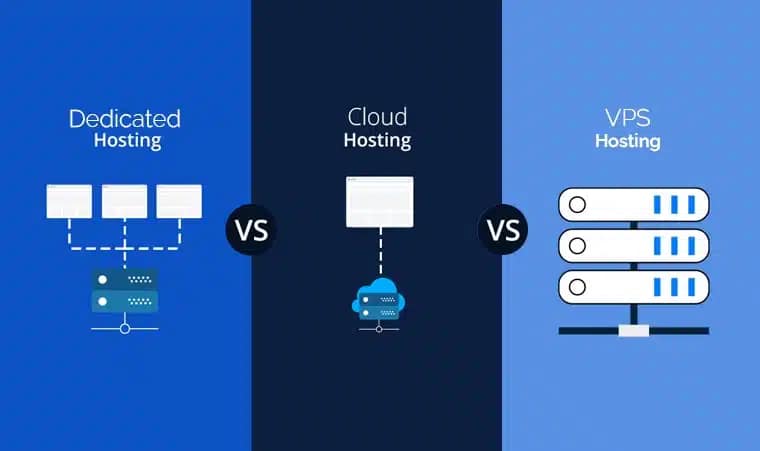
The choice between VPS, dedicated server, and cloud depends primarily on project size, budget, scalability needs, and desired level of control. Below is a practical and straightforward guide to understanding the differences and knowing when to use each option.
1️⃣ VPS (Virtual Private Server)
What is it?
A VPS is a virtual server created within a physical server, using virtualization (KVM, VMware, Xen, etc.).
Each VPS has dedicated resources (CPU, RAM, disk), but shares the physical hardware.
Advantages
- Affordable cost 💰
- Guaranteed resources
- Full root access
- Good performance for medium-sized projects
- Easy plan upgrade
Disadvantages
- Physical host limit
- Lower performance than a dedicated server
- Can be impacted if the host is overloaded (in poor providers)
When to use it
✅ Medium-sized WordPress sites
✅ Small and medium-sized online stores
✅ Email servers
✅ Testing and staging environments
✅ Hosting multiple websites with cPanel/DirectAdmin
👉 Ideal for those who want performance and control without spending too much
2️⃣ Dedicated Server
What is it?
A dedicated server is an entire physical machine exclusively for you, with no resource sharing.
Advantages
- Maximum performance 🚀
- Total hardware control
- Predictable stability
- Ideal for heavy workloads
- No “neighbors” consuming resources
Disadvantages
- High cost 💸
- Limited scalability (upgrades require hardware replacement)
- More complex maintenance
- Slower provisioning
When to use it
✅ Large online stores (high traffic)
✅ Corporate systems
✅ Large databases
✅ Game servers
✅ Streaming, heavy APIs
✅ Environments with high CPU and I/O usage
👉 Ideal when peak performance is a priority.
3️⃣ Cloud
What is it?
Cloud uses distributed infrastructure, with multiple servers working together.
Examples: AWS, Google Cloud, Azure.
Advantages
- High automatic scalability 📈
- High availability (HA)
- Pay-as-you-go
- Fast recovery in case of failure
- Ideal for traffic spikes
Disadvantages
- Cost can be high if poorly configured
- Greater complexity
- Dependence on good architecture
- Overhead compared to bare metal
When to use it:
✅ SaaS applications
✅ Systems with variable traffic
✅ APIs and microservices
✅ Critical high availability
✅ Projects that need to scale quickly
👉 Ideal for modern and scalable projects.
📊 Quick comparison
| Feature | VPS | Dedicated | Cloud |
|---|---|---|---|
| Cost | Low to medium | High | Variable |
| Performance | Good | Excellent | Good to excellent |
| Scalability | Limited | Low | High |
| Control | High | Total | High |
| Ease of management | High | Average | Low average |
| High availability | Not native | Not native | Yes |
🎯 Which one to choose?
- Blog, WordPress, WHMCS, medium-sized websites → VPS
- Large e-commerce, heavy banking, games → Dedicated server
- SaaS, apps, APIs, peak traffic → Cloud
- Professional hosting with CloudLinux → VPS or Dedicated server