
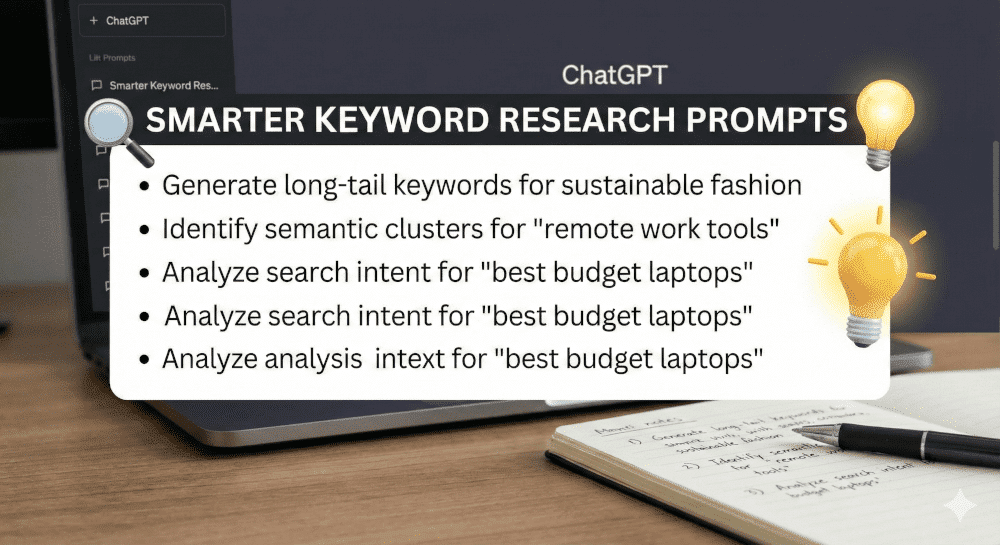
We are constantly looking for ways to improve our SEO strategies. One way to do this is by using artificial intelligence tools, such as ChatGPT, to optimize keyword research.
By leveraging ChatGPT’s capabilities, we can create personalized prompts that help us discover new keyword opportunities and better understand what our users are searching for.
With its ability to process large volumes of data, ChatGPT allows us to refine our SEO strategies more effectively.
Key Conclusions
- Use ChatGPT to improve keyword research.
- Create personalized prompts to discover new opportunities.
- Optimize SEO strategies with the help of artificial intelligence.
- Improve understanding of user needs.
- Refine SEO strategies more effectively.
The Power of ChatGPT in Keyword Research
With its ability to process large volumes of data, ChatGPT is changing the game in keyword research. The artificial intelligence behind ChatGPT allows for a deeper and more accurate analysis of search trends.
How AI is revolutionizing SEO in Brazil
AI is ushering in a new era for Brazilian SEO, enabling companies to optimize their content more effectively. With ChatGPT, we can uncover keyword opportunities that were previously difficult to identify.
Advantages of using ChatGPT to discover keyword opportunities.
Using ChatGPT for keyword research offers several advantages. Two of the main ones are:
Saving time and resources
ChatGPT automates much of the research process, saving time and resources that can be allocated to other important areas of SEO.
Insights that traditional tools don’t offer.
Furthermore, ChatGPT provides innovative insights that traditional keyword research tools cannot offer, helping to create more effective content strategies.
| Vantagens | Descrição |
|---|---|
| Time Saving | It automates the search, saving time. |
| Innovative Insights | It offers insights that traditional tools don’t provide.. |
Understanding the Fundamentals of Keyword Research
Keyword research is a crucial component of SEO, and understanding its fundamentals is essential for any successful digital marketing strategy. In this section, we’ll explore the basic concepts needed for effective research and discuss the limitations of traditional methods, as well as how ChatGPT can complement these approaches.
Basic concepts you need to master before you begin.
Before starting any keyword research, it’s important to understand some fundamental concepts. Keywords are terms that users type into search engines to find information. The search intent behind these keywords is equally important, as it defines what the user is actually looking for. Furthermore, understanding the competition and difficulty associated with certain keywords helps to define more effective strategies.
Why traditional keyword research has limitations
Traditional keyword research often relies on tools that provide historical data and algorithm-based analysis. However, these approaches can be limited by a lack of context and an inability to fully understand user intent. Furthermore, the static nature of these tools may not keep pace with rapidly changing search patterns and market trends.
“Keyword research isn’t just about finding words; it’s about understanding what users want.”
How ChatGPT complements conventional methods.
ChatGPT can be a valuable tool to complement traditional keyword research methods. With its ability to understand and generate natural language, ChatGPT can help identify relevant keywords, suggest variations, and even better understand the intent behind searches. Furthermore, it can help create more targeted and relevant content.
| Method | Advantages | Disadvantages |
|---|---|---|
| Traditional Research | Historical data, algorithmic analysis | Lack of context, static. |
| ChatGPT | Natural language understanding, dynamic suggestions | Dependence on training data |
By combining traditional methods with ChatGPT’s ability to understand and generate insights, we can create a more robust and effective keyword research strategy.
Preparing to Use ChatGPT Prompts for Smarter Keyword Research
Before we delve into the world of ChatGPT prompts, it’s crucial to lay the groundwork for smarter keyword research. This involves not only understanding ChatGPT’s capabilities but also setting up your account effectively and choosing the right tools for your SEO work.
Setting up your account and choosing the right plan.
When starting your journey with ChatGPT, the first step is to set up your account. This includes choosing the plan that best suits your SEO needs. It’s important to consider the volume of searches you intend to perform and any additional features you may require, such as integrations with other SEO tools.
Understanding the different models and their capabilities for SEO.
ChatGPT offers different templates, each with its own capabilities and limitations. Understanding these differences is crucial for choosing the template that best suits your keyword research needs. Some templates are better suited for complex research, while others may be more efficient for simpler tasks.
Complementary tools to enhance your results.
In addition to ChatGPT, there are several complementary tools that can enhance your SEO results. These include competitor analysis tools, SEO auditors, and content management platforms. Integrating these tools with ChatGPT can provide valuable insights and improve the effectiveness of your keyword research.
| Tool | Description | Benefit for SEO |
|---|---|---|
| Competitive Analysis | Detailed analysis of competitors’ SEO strategies. | Identifying gaps and opportunities |
| SEO Auditors | Technical analysis of the website to identify SEO problems. | Improved website performance in search engines. |
| Content Management Platforms | Organization and optimization of website content. | Improving the relevance and authority of the website. |
Structuring Effective Prompts for Keyword Research
When using ChatGPT for keyword research, it’s crucial to understand how to structure effective prompts. “The way you ask the question determines the quality of the answer” is a saying that perfectly applies to using ChatGPT to discover valuable keywords.
Anatomy of a perfect prompt for extracting valuable keywords.
Creating an effective prompt involves understanding its essential elements and how to contextualize them appropriately.
Essential elements of a good prompt
A good prompt should be clear, concise, and specific. It should include relevant keywords and indicate the type of information desired.
Contextualization techniques
Contextualization is crucial for obtaining relevant results. This can be done by providing information about the niche, target audience, and specific research objectives.
Prompt engineering techniques for accurate results.
Prompt engineering involves adjusting and refining prompts based on the results obtained. This may include adjusting specificity, adding or removing details, and altering the prompt structure.
Common mistakes to avoid when creating your prompts.
Common mistakes include being too vague, not providing enough context, and not reviewing results to adjust prompts. Avoiding these mistakes can significantly improve the effectiveness of your keyword research with ChatGPT.
By using these techniques and avoiding common errors, we can maximize ChatGPT’s potential for discovering valuable keywords and improving our SEO strategy.
10 Essential Prompts for Discovering High-Value Keywords
The key to successful keyword research lies in formulating the right prompts for ChatGPT. In this section, we’ll explore 10 essential prompts that can help you discover high-value keywords, optimizing your SEO strategy.
Prompts for identifying profitable long-tail keywords
Long-tail keywords are crucial for attracting qualified traffic. Use prompts like “List 10 long-tail keywords related to [your niche]” to uncover valuable opportunities.
Prompts for analyzing the search intent of Brazilian users.
Understanding search intent is vital for creating relevant content. Prompts like “What is the search intent behind the keyword [keyword]?” help to better understand the target audience.
Prompts to find unexplored niches in the national market
Exploring untapped niches can be a competitive advantage. Use prompts like “Identify untapped niches related to [your industry]” to discover new opportunities.
Prompts for generating content ideas based on keywords.
Create engaging content with prompts like “Generate 5 content ideas based on the keyword [keyword]”. This helps develop an effective content strategy.
By using these 10 essential prompts, you can enhance your keyword research and optimize your SEO strategy for the Brazilian market.
Using ChatGPT for Competitive Analysis
By using ChatGPT for competitor analysis, we can uncover valuable insights into our competitors’ SEO strategies. This allows us to adjust our own strategy to improve our visibility in search engines.
Prompts to identify competitors’ keyword strategies.
To identify competitors’ keyword strategies, we can create specific prompts for ChatGPT. For example, we can ask: “What are the most common keywords used by the main competitors in the SEO niche in Brazil?” or “How are my competitors optimizing their content for search engines?”
How to discover gaps and opportunities in competitors’ strategies.
In addition to identifying current strategies, ChatGPT can help us uncover gaps and opportunities. We can ask: “What are the gaps in my competitors’ keyword strategies?” or “What keyword opportunities have my competitors not yet explored?”
Analyzing the ranking potential and difficulty of keywords
ChatGPT can also help us analyze the ranking potential and difficulty of keywords. We can use prompts such as: “What is the ranking potential for the keyword ‘SEO in Brazil’?” or “How difficult is it to rank for the keyword ‘website optimization’?”
By using these strategies with ChatGPT, we can improve our competitive analysis and enhance our SEO strategy.
Advanced Strategies with ChatGPT for Semantic Search
When we delve into the world of semantic research, we discover that ChatGPT stands out as a powerful tool. With its ability to understand and process natural language, ChatGPT opens up new possibilities for more effective SEO strategies.
Creating Clusters of Related Keywords for Comprehensive Content
One of the main benefits of ChatGPT is the ability to create clusters of related keywords. This allows SEO professionals to develop more comprehensive and relevant content, increasing visibility in search engines.
Identifying Entities and Topics Relevant to Your Niche
ChatGPT is also useful for identifying relevant entities and topics within a specific niche. This helps to better understand what users are looking for and how to create content that meets their needs.
Prompts for Mapping the Complete Semantic Field of a Subject
To map the semantic field of a subject, we can use specific prompts that guide ChatGPT to provide detailed information. This includes:
- Identifying primary and secondary keywords
- Exploring related topics and subcategories
- Analyzing the search intent behind the keywords
Radial Topic Expansion Technique
The radial expansion technique involves starting with a central topic and expanding to related topics, creating a network of interconnected information.
Vertical Deepening Method
The vertical deepening method focuses on exploring a topic in depth, examining specific aspects and details.
The table below compares the traditional and semantic approaches to keyword research:
| Aspect | Traditional Approach | Semantic Approach with ChatGPT |
|---|---|---|
| Focus | Isolated keywords | Keyword and entity clusters |
| Analysis | Search volume and competition | Search intent and semantic context |
| Result | Content targeted to specific keywords | Comprehensive and relevant content |
By adopting advanced strategies with ChatGPT for semantic search, we can elevate our SEO strategies and improve online visibility.
Overcoming Limitations and Challenges of ChatGPT in Keyword Research
When using ChatGPT for keyword research, we encounter some challenges that need to be overcome. Although it is a powerful tool, ChatGPT is not perfect and has its limitations.
Dealing with outdated model information
One of the main limitations of ChatGPT is that its knowledge may be outdated. To address this, it is recommended to:
- Verify the cutoff date of the model’s knowledge.
- Use external sources to validate information.
- Perform periodic updates to the research.
Strategies for verifying the accuracy of the data obtained.
To ensure data accuracy, we can:
- Compare ChatGPT results with other reliable sources.
- Conduct A/B tests to validate the suggested keywords.
- Monitor the performance of the implemented keywords.
How to refine prompts when results are not satisfactory.
If the results are not satisfactory, we can refine our prompts by:
- Being more specific with the instructions
- Adjusting the tone and desired style
- Providing additional context for the template
Alternatives for when ChatGPT can’t help.
When ChatGPT isn’t enough, we can:
- Use other keyword research tools
- Consult SEO specialists
- Combine different methods to obtain more precise results
In short, although ChatGPT has its limitations, we can overcome them with appropriate strategies and a multifaceted approach.
Implementing Keyword Insights into Your Content Strategy
By implementing keyword insights into our content strategy, we can significantly increase our website’s visibility. This involves transforming keyword lists into content briefs, creating an editorial calendar based on ChatGPT insights, and measuring the success of our keyword strategy.
Transforming Keyword Lists into Content Briefs
With the keyword lists generated by ChatGPT, we can create detailed content briefs. This helps ensure that the content is relevant and engaging for the target audience.
- Identify the most relevant and high-value keywords.
- Create compelling titles and subtitles that incorporate these keywords.
- Develop content that addresses the audience’s needs and questions.
Creating an Editorial Calendar Based on ChatGPT Insights
A well-planned editorial calendar helps maintain consistency and relevance of content.
To create an effective editorial calendar, we should:
- Plan content in advance, considering important dates and relevant events.
- Use keyword insights to guide content creation.
- Regularly review and adjust the calendar based on results and feedback.
Measuring the Success of Your Keyword Strategy
To understand the impact of our keyword strategy, it’s crucial to measure its success with appropriate metrics.
Essential Metrics to Track
- Organic traffic: Monitor the increase in traffic from organic searches.
- Keyword ranking: Track the position of target keywords in search results.
- User engagement: Analyze metrics such as time on page and bounce rate.
Recommended Monitoring Tools
Several tools can help monitor these metrics, including Google Analytics and SEMrush.
Conclusion
While exploring how ChatGPT can revolutionize keyword research for SEO purposes, we discovered that by leveraging ChatGPT prompts, we can uncover valuable keywords, analyze the competition, and create comprehensive content strategies.
Using ChatGPT for keyword research allows us to access its vast capabilities, identifying long-tail keywords, understanding user intent, and discovering untapped niches in the Brazilian market. This not only improves our SEO efforts but also gives us a competitive edge.
By incorporating ChatGPT into our SEO workflow, we can streamline our research process, making it more efficient and effective. As we continue to adapt and refine our approaches, we can expect significant improvements in our online presence.
FAQ
What is ChatGPT and how can it help with keyword research?
ChatGPT is an artificial intelligence tool that can help generate content ideas, identify relevant keywords, and improve SEO strategy.
How do I set up my ChatGPT account?
To set up your ChatGPT account, you need to access the official website, create an account, and choose the plan that best suits your needs.
What are the advantages of using ChatGPT for keyword research?
The advantages include saving time and resources, gaining innovative insights, and the ability to identify keyword opportunities that traditional tools may miss.
How to create effective prompts for keyword research with ChatGPT?
To create effective prompts, it’s important to understand the anatomy of a perfect prompt, use contextualization techniques, and avoid common mistakes.
Can I use ChatGPT for competitor analysis?
Yes, ChatGPT can be used to create prompts that help identify competitors’ keyword strategies and uncover gaps and opportunities.
How to deal with outdated information in the ChatGPT model?
To deal with outdated information, it is important to verify the accuracy of the data obtained and refine the prompts when necessary.
How can I implement keyword insights into my content strategy?
You can transform keyword lists into content briefs, create an editorial calendar based on ChatGPT insights, and measure the success of your strategy.
What are the essential metrics for tracking the success of a keyword strategy?
Key metrics include keyword ranking, organic traffic, and user engagement.